What to look for in an ECN broker right now
ECN vs dealing desk: understanding what you're trading through
The majority of forex brokers fall into two broad camps: market makers or ECN brokers. The distinction matters. A dealing desk broker becomes the other side of your trade. ECN execution routes your order directly to liquidity providers — your orders match with actual buy and sell interest.
Day to day, the difference shows up in three places: whether spreads blow out at the wrong moment, how fast your orders go through, and whether you get requoted. Genuine ECN execution will typically offer raw spreads from 0.0 pips but apply a commission per lot. Dealing desk brokers widen the spread instead. Both models work — it comes down to your strategy.
If you scalp or trade high frequency, ECN execution is generally the right choice. The raw pricing more than offsets paying commission on the major pairs.
Why execution speed is more than a marketing number
Every broker's website mentions how fast they execute orders. Numbers like "lightning-fast execution" look good in marketing, but how much does it matter for your trading? It depends entirely on what you're doing.
A trader who executing two or three swing trades a week, a 20-millisecond difference doesn't matter. But for scalpers targeting small price moves, execution lag can equal slippage. Consistent execution at in the 30-40ms range with no requotes provides an actual advantage over one that averages 200ms.
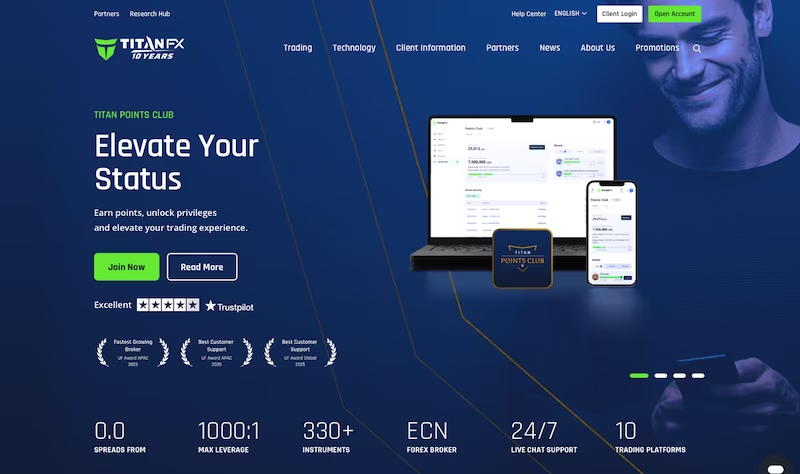
A few brokers built proprietary execution technology specifically for speed. One example is Titan FX's Zero Point technology which sends orders straight to LPs without dealing desk intervention — they report averages of under 37 milliseconds. You can read a detailed breakdown in this Titan FX broker review.
Raw spread accounts vs standard: doing the maths
Here's the most common question when picking an account type: is it better to have a commission on raw spreads or zero commission but wider spreads? The answer varies based on volume.
Take a typical example. The no-commission option might have EUR/USD at around 1.2 pips. A raw spread account gives you 0.1-0.3 pips but applies a commission of about $7 per lot round-turn. With the wider spread, you're paying through the markup. If you're doing moderate volume, the commission model works out cheaper.
A lot of platforms offer both as options so you can pick what suits your volume. Make sure you work it out using your real monthly lot count rather than trusting hypothetical comparisons — those tend to be designed to sell one account type over the other.
High leverage in 2026: what the debate gets wrong
The leverage conversation polarises the trading community more than any other topic. Tier-1 regulators like ASIC and FCA limit retail leverage at 30:1 or 50:1 depending on the asset class. Platforms in places like Vanuatu or the Bahamas can still offer 500:1 or higher.
Critics of high leverage is simple: retail traders can't handle it. Fair enough — the numbers support this, traders using maximum leverage do lose. What this ignores a key point: professional retail traders never actually deploy 500:1 on every trade. What they do is use the availability high leverage to reduce the money locked up in open trades — which frees capital for other opportunities.
Obviously it carries risk. Nobody disputes that. But that's a risk management problem, not a leverage problem. When a strategy needs lower margin requirements, the option of higher leverage frees up margin for other positions — most experienced traders use it that way.
VFSC, FSA, and tier-3 regulation: the trade-off explained
Broker regulation in forex falls into different levels. At the top is FCA (UK) and ASIC (Australia). You get 30:1 leverage limits, enforce client fund segregation, and put guardrails on what brokers can offer retail clients. Tier-3 you've got jurisdictions like Vanuatu and Mauritius and similar offshore regulators. Fewer requirements, but that also means more flexibility in what they can offer.
The trade-off is not subtle: going with an offshore-regulated broker gives you 500:1 leverage, fewer account restrictions, and often lower fees. In return, you get less investor protection if there's a dispute. No compensation scheme like the FCA's FSCS.
For traders who understand this trade-off and choose execution quality and flexibility, regulated offshore brokers work well. The key is looking at operating history, fund segregation, and reputation rather than only checking if they're regulated somewhere. A platform with 10+ years of clean operation under tier-3 regulation can be more reliable in practice than a brand-new tier-1 broker.
Scalping execution: separating good brokers from usable ones
For scalping strategies is the style where broker choice matters most. Targeting small ranges and staying in positions for seconds to minutes. At that level, tiny gaps in spread equal real money.
What to look for comes down to a few things: 0.0 pip raw pricing with no markup, order execution under 50 milliseconds, zero requotes, and the broker allowing holding times under one minute. Some brokers say they support scalping but slow down orders if you trade too frequently. Check the fine print before committing capital.
Platforms built for scalping will put their execution specs front and centre. Look for their speed stats disclosed publicly, and they'll typically offer VPS hosting for running bots 24/5. If the broker you're looking at doesn't mention their execution speed anywhere on the website, take it as a signal.
Following other traders — the reality of copy trading platforms
Social trading took off over the past decade. The concept is obvious: find someone with a good track record, replicate their positions in your own account, benefit from their skill. In practice is more complicated than the marketing suggest.
The biggest issue is the gap between signal and fill. When the trader you're copying enters a trade, the replicated trade fills with some lag — and in fast markets, the delay can turn a profitable trade into a losing one. The more narrow the average trade size in pips, the worse the impact of delay.
Despite this, a few implementations work well enough for traders who don't have time to trade actively. What works is platforms that show audited trading results over at least a year, not just demo account performance. Looking at drawdown and consistency matter more than the total return number.
Certain brokers have built their own social trading integrated with their main offering. Integration helps lower the execution lag compared to third-party copy services that sit on top of the source broker's platform. Look at how the copy system integrates before expecting the results will translate in your experience.